Now How Do We Preserve That Mission Today –

The Big Picture –
By Glynn Wilson –
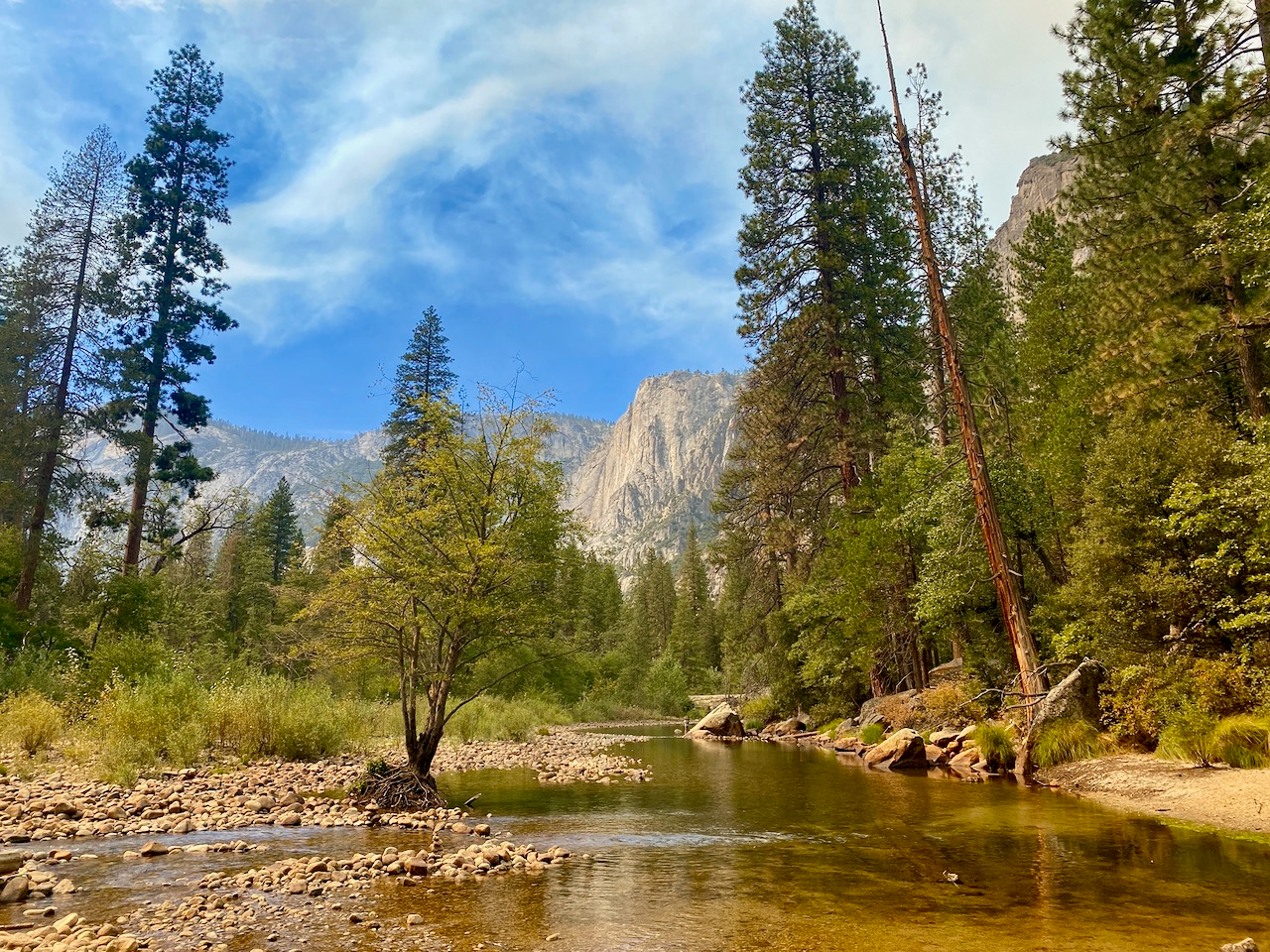
YOSEMITE NATIONAL PARK, Calif. – Sitting quietly in a camp chair at dusk and dawn by a small fire in the North Pines Campground in Yosemite Valley, the monumental problems of the world seem to vanish for a few brief moments and time seems almost suspended.
Finally relaxed and unhooked from the internet and all the apocalyptic news of the world, a series of pictures moved through my head like a flashback replaying the history of time itself.

With the great Milky Way galaxy and the shooting stars visible overhead in this dark place far from the developed world, it is not hard to set aside ones’ selfish cravings and self-centered ego and take note of how small we all are, passing briefly upon this grand landscape like the stars flaming out in the night sky above.
After aiming my own camera at these scenes immortalized by Ansel Adams and artists like Albert Bierstadt and Thomas Moran before him, described so sublimely by John Muir in his day, I can’t help but feel lucky to make it here at all.

The Painted Picture
Long before Ansel Adams endured the long trips into the High Sierras to get his camera and tripod into position at the right moment of light at dawn and dusk, Bierstadt made the arduous journey and captured the scenes with paint on canvas at a time when the United States was rapidly expanding to the west. As the railroads opened up the country to timber harvesting, gold mining and the first explorations of the region in a new industry that came to be called tourism, the continent was being transformed and nature itself was at risk – along with the future direction of human cultural evolution.
Lucky for us, some smart people saw this place and others like it and recognized that if left to the base greed of less than honorable humans, capitalist development would surely destroy in an instant what only millennia of natural evolution could create.
Bierstadt was one of the first to hear about Yosemite and made it his point to travel here in the 1860s. The art he created – enormous, luminous landscapes filled with towering mountains, waterfalls, old growth forests and dramatic skies – began to transform how people literally came to see the world.
The images in my head came from seeing those paintings not just with a Google search on an iPhone, but up close and personal in the White House, Smithsonian Museums, national galleries in New York and Washington, the Department of Interior museum in Washington and the Smithsonian’s Buffalo Bill Center of the West in Cody, Wyoming.
Bierstadt belonged to the Hudson River School, a loose movement of American landscape painters who emphasized the grandeur and spiritual qualities of nature. His 1868 painting of Yosemite Valley became particularly influential depicting the sublime landscape as vast, dramatic and largely undisturbed by humankind.


The Word
The writer John Muir arrived in Yosemite in 1868, the same year Bierstadt completed his celebrated Yosemite painting as the valley was already becoming famous beyond California.
While Bierstadt showed Yosemite’s grandeur, Muir studied glaciers, trees, waterfalls, wildlife and geology, explaining its living systems so interested people could more fully understand the need to preserve it. He argued that Yosemite was not simply spectacular scenery, but an interconnected natural system that could be destroyed if not protected in perpetuity.
He described granite walls rising above the valley floor and Merced River like monuments built by forces beyond human imagination at the time, only explained by science as the years rolled by. With waterfalls plunging from cliffs into forests of pine and cedar, and oh the giant sequoias, some older than any nation on Earth.
“No temple made with hands can compare with Yosemite,” he wrote.

“Every rock in its wall seems to glow with life.”


Muir came back the following year and spent several years living and working in the Sierra tending sheep in the high country while making a study of the native plants, animals, glaciers and mountains. Muir’s descriptions helped influence the emerging conservation movement, eventually contributing to the long-term national protection of Yosemite and many other special places that became national parks, forests and monuments of nature.
Presidential Power

Hanging out on the way to and from Yosemite and Hetch Hetchy Valley in foothill towns like Coulterville in Mariposa County, Muir finally lured President Theodore Roosevelt to camp in the park in May, 1903. Roosevelt was already an energetic conservationist when he became president in 1901. But his meeting with Muir in Yosemite became one of the defining encounters in the early history of American environmental protection.
Roosevelt wrote to Muir before the trip that he wanted to “drop politics absolutely for four days and just be out in the open with you.”
Turning down a big banquet in San Francisco on May 12, Roosevelt met Muir with a small Army troop at the Oakland Pier. From there they boarded a train headed south toward Merced at midnight. After arriving in Raymond on the night of May 14 and taking a stage coach the final 40 miles up to the south end of the park, they arrived on the morning of the 15th, brushing off parties of curious onlookers. They camped beneath the ancient Grizzly Giant in the Mariposa Grove, and camped another night near Sentinel Dome during a snowstorm. Their final night was spent near Bridalveil Fall in Yosemite Valley.
At the Mariposa Grove, Roosevelt reportedly described the giant sequoias as “a temple greater than any human architect could by any possibility build.”
On the train and around the campfire, Muir talked about the threats facing the Sierra and forests across the country. According to documentation by the National Park Service, Muir used the opportunity to discuss destructive logging, harmful development practices and other threats to the forests and most special places in nature. He later recalled that he had “stuffed him pretty well regarding the timber thieves, and the destructive work of lumbermen and other spoilers of the forest.”
The federal government eventually assumed control of Yosemite Valley and the Mariposa Grove, helping establish the modern conception of a national park as a protected landscape with public access. It launched a movement and created a profession – the National Park Service Ranger with iconic hat – that spread like democracy across the globe.
The conservation movement expanded dramatically during Roosevelt’s presidency. The National Park Service credits his administration with creating five national parks, 18 national monuments, 55 national bird sanctuaries and wildlife refuges, and 150 national forests.

Then along came Ansel Adams.
The Photograph

By the 20th century, photography became a thing, and photographer and environmentalist Ansel Adams showed up on the scene.
Adams first visited Yosemite as a teenager in 1916. The experience profoundly influenced the direction of his life and career. He would return again and again, eventually making the Sierra Nevada and Yosemite among the central subjects of his photography.
Where Bierstadt used paint on canvas and John Muir used language to persuade people that Yosemite possessed almost spiritual value, Adams used light, shadow and composition to make that argument visually and spread the news to the masses.
His photographs of Half Dome, El Capitan, Yosemite Valley and the high Sierra became some of the most recognizable images of the American wilderness. One of his most famous photographs, “Moon and Half Dome,” transformed a familiar Yosemite landscape into something almost otherworldly. Another, “Clearing Winter Storm,” captured Yosemite Valley emerging from dramatic weather and became an enduring image of the park.


Adams was not simply documenting scenery. He believed photography could help Americans understand what was at stake in preserving wild places.
His relationship with Yosemite also connected him directly to Muir’s legacy. Adams served on the board of the Sierra Club and became one of the organization’s most important photographic voices. His images appeared in Sierra Club publications and helped bring wilderness conservation to a national audience.
The Power of Art and the Future of Humanity
In that sense, the history of Yosemite and the national parks, what has been called “America’s Best Idea,” can be seen as a progression of three powerful forms of persuasion: Art, journalism and photography.
Now the question becomes: Can the power of art, the written word and photography hold onto to its power of persuasion in a selfish world seemingly gone mad in the 21st century?
That remains to be seen.
This movement made us a better people, a better country. It must not be allowed to unravel.
A.I. bots are now replacing artists, writers and photographers, as well as others in the work force, and politicians who support the massive transformation of society by Artificial Intelligence and its data centers seem to have lost sight of the central mission here.
We make it our mission to see that art, the written word and photography too are preserved, as well as the golden landscapes they helped to protect in the first place. That is our mission on Yosemite Radio and in the Yosemite Arts and Crafts Center in Coulterville and with the Operation New Earth nonprofit.
This is no small mission. It is the mission inherent that must endure for the very survival of human life and civilization on planet Earth.
Related Coverage
This May Be Our Last Chance to Save the World
Dome Fire in Yosemite Closes Popular Waterfall Hike, While the Smoke Hangs Over the Valley
Father’s Day from the White House
More Photos From This Trip


There are many ways you too may become involved to help.
__
If you like this story and independent radio news service you can help Fund Yosemite Radio, KNHA 100.9 FM with GoFundMe.

Leave a Reply