|
Getting your Trinity Audio player ready…
|
Tales From the MoJo Road –
By Glynn Wilson –
COULTERVILLE, Calif. – Even before John Muir discovered Yosemite and wrote about the faces in the rock mountains, even before the native Miwoks inhabited the land, the Mono Lake Paiute people had their stories and legends about the place.
These days you might hear different versions of these legends, depending on who you talk to and where you look.
I’ve written about similar legends before, in Shenandoah and other places.
Shenandoah: Daughter of the Stars
Native Legends Define Special Places in Nature
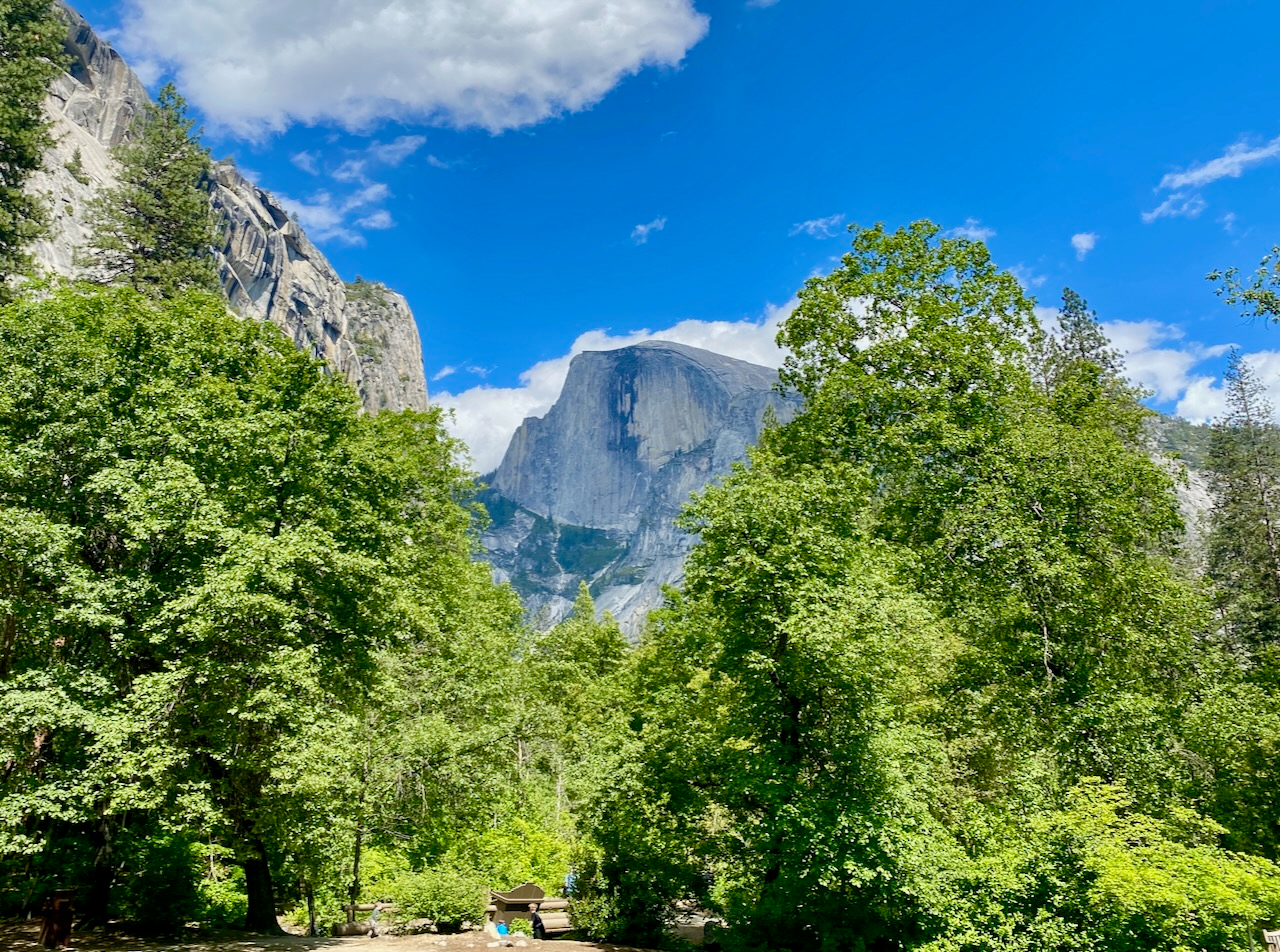
I found out about this legend on Tuesday talking to a vounteer artist in a visit to the Made in Mariposa store. There was a framed photograph of Half Dome hanging on the wall, and an artist named Coop pointed out the woman’s face in the granite rock and told us a version of this story.
In the traditions of the Yosemite and Mono Lake Paiute people, Half Dome is not just a striking granite formation — it is the transformed face of Tissayack, an old woman whose story explains its shape and features. According to the legend, long before the Valley of Ahwahnee was shaped, a couple lived in the arid lands around Mono Lake. Inspired by stories of the fertile valley, they decided to move there.

The woman carried a heavy, cone-shaped basket woven from reeds and coarse grasses, while her husband walked with only a walking stick, according to Undiscovered-Yosemite.com. On their journey, they reached a beautiful mountain lake. The woman drank so deeply that by the time her husband arrived, the lake was gone, causing a drought that dried up the valley.
Enraged, her husband raised his stick to strike her. She fled, crying, and hurled her basket at him. The Great Spirit was angered and transformed them into stone, it is said. She became Half Dome, and he became the Washington Column.
In some versions, the woman also carried a baby cradle. When she ran away, she threw it at her husband, and it became the Royal Arches, according to the Northern Nevada Weekly. The couple’s quarrel angered the Creator, who turned them to stone as punishment.
Tissayack is said to have regretted her actions. Her stone form began to “cry,” and the tears formed Mirror Lake.
Today, visitors can still see the stains on Half Dome’s face as if it is weeping. The rock’s face is also described as resembling the way the Mono Lake Paiute people once wore their hair — bobbed and with bangs.
In Paiute, her name is T’ssiyakka (pronounced Tissayack), and in olden times white explorers called her “South Dome,” then later “Half Dome.”
This legend is part of the rich oral history of Yosemite, blending natural features with cultural memory, and remains a poignant reminder of the valley’s deep Indigenous heritage.

John Muir Described the Faces in 1890
In his day, John Muir first visited Yosemite going from San Francisco through Coulterville by train, stage coach, horse and mule and on foot in 1890, and even he talks about the faces in the granite mountain walls.
Early geologists believed that the Yosemite Valley was created by a series of earthquakes that sank the valley floor, including state geologist Josiah Whitney. Muir examined the land and concluded that glaciers had been the main agent for the valley’s creation. Science later proved Muir to be right in his theory.
On the west side of the mountain range that separates the states of California and Nevada, no one calls it the Sierra-Nevada Mountains. Even Muir simply called it “The Sierra,” and when he visited in 1890, it appeared to him as if no human had ever been there to impact the place.
“The Sierra is about 500 miles long, 70 miles wide, and from 7000 to nearly 15,000 feet high,” Muir wrote of his first visit in a story headlined “The Treasures of the Yosemite” in The Century Magazine, Vol. XL. August, 1890. No. 4.
“In general views no mark of man is visible upon it, nor anything to suggest the wonderful depth and grandeur of its sculpture. … Nevertheless the whole range is furrowed with cañons to a depth of from 2000 to 5000 feet, in which once flowed majestic glaciers, and in which now flow and sing the bright Sierra rivers.”
“Though of such stupendous depth, these cañons are not raw, gloomy, jagged-walled gorges, savage and inaccessible. With rough passages here and there, they are mostly smooth, open pathways conducting to the fountains of the summit; mountain streets full of life and light, graded and sculptured by the ancient glaciers, and presenting throughout all their courses a rich variety of novel and attractive scenery — the most attractive that has yet been discovered in the mountain ranges of the world. …”
“The most famous and accessible of these cañon valleys, and also the one that presents their most striking and sublime features on the grandest scale, is the Yosemite, situated on the upper waters of the Merced (River) at an elevation of 4000 feet above the level of the sea. It is about seven miles long, half a mile to a mile wide, and nearly a mile deep, and is carved in the solid granite flank of the range.
“The walls of the valley are made up of rocks, mountains in size, partly separated from each other by side cañons and gorges; and they are so sheer in front, and so compactly and harmoniously built together on a level floor, that the place, comprehensively seen, looks like some immense hall or temple lighted from above.
“But no temple made with hands can compare with Yosemite. Every rock in its walls seems to glow with life. Some lean back in majestic repose; others, absolutely sheer or nearly so for thousands of feet, advance beyond their companions in thoughtful attitudes giving welcome to storms and calms alike, seemingly conscious, yet heedless of everything going on about them. Awful in stern, immovable majesty, how softly these mountain rocks are adorned and how fine and reassuring the company they keep — their feet set in groves and gay emerald meadows, their brows in the thin blue sky…
“Birds, bees, butterflies, and myriads of nameless wings stir the air into music and give glad animation. Down through the midst flows the crystal Merced — river of mercy — peacefully gliding, reflecting lilies and trees and the onlooking rocks, things frail and fleeting and types of endurance meeting here and blending in countless forms, as if into this one mountain mansion Nature had gathered her choicest treasures, whether great or small to draw her lovers into close and confiding communion with her…
“Thus it appears that Yosemite, presenting such stupendous faces of bare granite, is nevertheless embedded in magnificent forests. All the main species of pine, fir, spruce, and libocedrus are also found in the valley itself. …
Another Version of The Legend of Tissayack (Tis-sa-ack)

Many, many generations ago, long before the Creator had completed the fashioning of the magnificent cliffs in the Valley of Ahwahnee, there dwelt in the arid desert around Mono Lake an Indian couple. Learning from other Indians of the beautiful and fertile Valley of Ahwahnee, they decided to go there and make it their dwelling place. They began their journey into the Sierra Nevada toward Yosemite Valley, he carrying deer skins, and she holding a baby cradle in her arms and carrying a (wono) basket on her back. When the couple reached the site of present-day Mirror Lake, they began to quarrel. She wanted to go back to Mono Lake, but he refused, saying that no oaks or other trees grew there. He would not listen to her when she said she would plant seeds.
In despair, the girl began to cry and ran back toward the Paiute homeland of Mono Lake. Her husband grew angry and ran after her. To escape she threw the wono basket at him and it became Basket Dome. She continued running and threw the baby cradle at her husband. Today, we experience it as the Royal Arches. Because they had brought anger into Yosemite, the Creator became upset at the couple. The Creator in his anger turned the two into stone. He became North Dome and she became what we know as Half Dome. The Mono Lake Paiute girl regretted the quarrel and the rock wall she became, Half Dome, began to cry, thus forming Mirror Lake.
Today, you can still see the marks of those tears as they run down her face. And if you look very carefully at Half Dome, you can see it is fashioned after the way the Mono tribe looked, hair bobbed and cut in bangs. Her rock face stained with tears facing eastward towards their ancient homeland of Mono Lake. In olden times the first white explorers called her South Dome, later Half Dome, but in Paiute she is known as T’ssiyakka or the English pronunciation Tissayack.
For decades many historians have scratched their heads to the meaning of Tissayack.
Mistakenly they kept asking Mariposa Indians also known as Miwoks believing them to be the original Yosemite Indians and tellers of the legend, but if they had asked Paiutes in the area they would have translated it for them.
T’ssiyakka means “crying girl” or in Paiute “girl-cry,” which fits the legend of Half Dome and not the “Legends of the Yosemite Miwoks” of the girl turned to stone with tears running down her face.
The legend of Tis-sa-ack, or “River of Sorrow,” is not merely a tale lost to time but the very soul of Yosemite Valley. It is a monument to love and loss, solidified into the magnificent granite of Half Dome. This towering peak was not solely born from geological forces but from the endless tears of grief shed by a woman named Tis-sa-ack.

https://www.facebook.com/photo/?fbid=10235949208695015&set=gm.27708380508796305&idorvanity=1018246824903036
The Face of El Capitan
On my first visit to Yosemite back in October, 2025, I took a photo of El Capitan that shows his rock chief face like no other photograph I’ve ever seen.

El Capitan (Spanish: El Capitán; lit. ’the Captain’) is a vertical rock formation in Yosemite National Park, on the north side of Yosemite Valley, near its western end, according to its Wikipedia entry.
The granite monolith is about 3,000 feet (914 m) from base to summit along its tallest face and is a world-famous location for big wall climbing, including the disciplines of aid climbing, free climbing, and more recently for free solo climbing. The top of El Capitan can be reached by hiking out of Yosemite Valley on the trail next to Yosemite Falls, then proceeding west. For climbers, the challenge is to climb up the sheer granite face. There are many named climbing routes, all of them arduous, including Iron Hawk and Sea of Dreams.
Naming
The formation was named El Capitán by the Mariposa Battalion when they explored the valley in 1851. El Capitán (‘the captain’) was taken to be a loose Spanish translation of the local Native American name for the cliff, Tutokanula, meaning ‘rock chief’ (the exact spelling of Tutokanula varies in different accounts as it is a phonetic transcription from the Miwok language).[4]
The “Rock Chief” etymology is based on the written account of Mariposa Battalion doctor Lafayette Bunnell in his 1892 book.[5] Bunnell reports that Ahwahneechee Chief Tenaya explained to him in 1851 that the massive formation, called Tutokanula, could be translated as ‘rock chief’ because the face of the cliff looks like a giant chief made of rock. In Bunnell’s account, however, he notes that this translation may be wrong…[5]
An alternative etymology is that Tutokanula is Miwok for ‘inchworm rock’.[6] Julia F. Parker, the preeminent Coast Miwok-Kashaya Pomo basket-weaver and Yosemite Museum cultural ambassador since 1960, explains that the name Tutokanula, or ‘inchworm rock’, originates in the Miwok creation story for the giant rock, a legend in which two bear cubs are improbably rescued by a humble inchworm. In the story, a mother bear and her two cubs are walking along the river. The mother forages for seeds and berries while the two cubs nap in the sun on a flat rock. While the cubs sleep, the rock grows and grows, above the trees and into the sky. The mother bear is unable to climb the rock to get to her cubs and she becomes afraid and asks for help. The fox, the mouse, the mountain lion, and every other animal tries to climb to the top of the giant rock but they each fail. Finally, the lowly little inchworm tries the climb and successfully makes it all the way to the top and rescues the cubs. All the animals are happy to see that the little inchworm has saved the two bear cubs and the rock is named in the inchworm’s honor.[7]
The ‘inchworm rock’ version of the meaning of Tutokanula is also described in the story Two Bear Cubs: A Miwok Legend from California’s Yosemite Valley by Robert D. San Souci[8] and in the First People Miwok recounting of the El Cap legend.
__
If you like this story and independent radio news service you can help Fund Yosemite Radio, KNHA 100.9 FM with GoFundMe.
Comments
5 responses
Thank you for sharing these bits of historical legends
Sure man. Interesting stories.
I appreciate you reprinting the truth / TY
Many locals don’t know this…impressive…this is being sent to our Vietnamese visitors (one of our former students accompanied us on this adventure) to share as well. It is interesting to note, they (Vietnamese) have similar mountain-people-creator stories!
Very interesting. I never knew this history.