|
Getting your Trinity Audio player ready…
|

Tales From the MoJo Road –
By Glynn Wilson –
COULTERVILLE, Calif. – As an experienced national park visitor, camper and volunteer, there is no way I would try to visit a big name national park like Yosemite on a big national holiday like Independence Day, even living 31 miles down the mountain from the Big Oak Flat Entrance on Highway 120.
Especially not after the Trump administration canceled the reservation system and made getting into name national parks a free for all and waved the entrance fee on the biggest holiday of the summer.
But the New York Times sent a correspondent all the way from San Francisco into Yosemite this weekend to check out the scene. The story?
Yosemite Offers Many Wonders. Crushing Crowds Are Now One of Them.
“Visitors are enduring especially long waits at the popular national park after the Trump administration eliminated a summer reservation system,” they report.
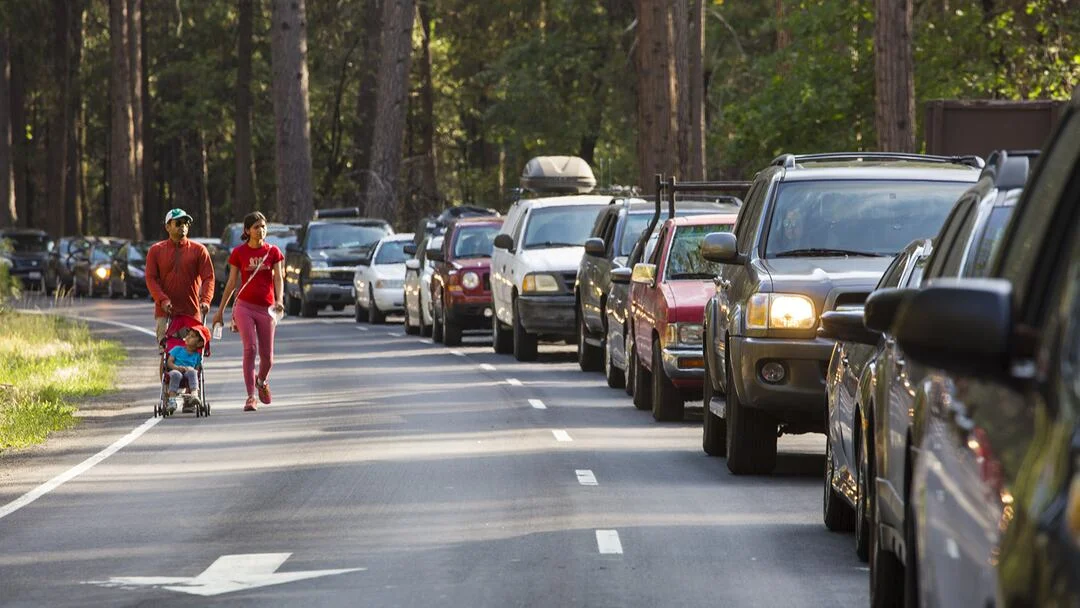
“The crown jewel of the nation’s park system, Yosemite (was) even more crowded than usual this year, after a decision by the Trump administration to do away with summer reservations here and at other popular parks. In the first half of 2026, visitors to and employees of California’s regal wilderness park reported hourslong traffic jams, waits at entrance stations and long lines just to purchase a bite to eat.”
Employees of Yosemite, speaking off the record for fear of retribution, and organizations that support the park and its rangers and other workers, say that the “hordes of visitors are demoralizing staff and damaging the park, as well as its reputation.”
Many visitors they talked to said they were determined to make the most of their visit, even with long waits.
“But some travelers have abandoned their plans altogether and driven out of the park’s gates after being turned away from every at-capacity major attraction,” they report.
On Friday morning, so many people had already arrived at Yosemite Valley, known for its sprawling meadows and towering palace of granite rock faces, that by 7 a.m. drivers were circling lot after lot as they tried to find a spot.
“The traffic is terrible in the park,” said Lakshmi Duddukuru, 41, who spent 45 minutes of her first trip to Yosemite searching for a parking space, speaking as she scaled the steep Mist Trail, where throngs of hikers were ascending in a slowly snaking line.
Yosemite offers free shuttles to transport visitors between popular destinations, but many were too full to pick up any of the dozens of people waiting at the stops.
Yosemite Valley and the surrounding forest helped inspire the creation of the U.S. Forest Service and the national park system after Sierra Club founder John Muir lured President Teddy Roosevelt there for a camping trip in 1903. It was already the first government protected land to be designated for public use as a state park in an act signed in 1864 by President Abraham Lincoln.
“Its waterfalls and glacier-carved monoliths, such as Half Dome and El Capitan, have made it one of the country’s most beloved national parks — and most visited,” as the Times reports.
Yosemite and other parks began experimenting with a summer reservation system back in 2020 during the Covid pandemic to manage the growing summer crowds, when people turned to national parks as places to escape packed cities and get back to nature.
But Yosemite, as well as Arches National Park and Glacier National Park, did away with reservations this year, after President Trump signed an executive order urging parks to rescind restrictions to ostensibly improve access and help local economies.
Ray McPadden, Yosemite’s new superintendent, said that a reservation system should be a last resort since some visitors were turned away in previous years when they failed to book a visit in advance. He claimed it was unfair and resulted in some lost fees that could have gone toward fixing up trails, campgrounds and bathrooms.
In talking to the Times reporter, he did not seem concerned about the damage to the park and its reputation from over crowding.
The Times found some park employees who disagreed, and cited a statement by the union representing Yosemite staff, NFFE Local 465, which said the decision to end the reservation system had undermined the staff and was “disheartening and disappointing,” particularly when the park was short-staffed after other federal budget cuts by this administration.
Gridlock traffic in the park lengthens staff members’ commutes and makes it difficult, if not impossible, for them to perform their duties, the union said.
Advocacy organizations point out that Yosemite did not benefit from fee revenue over the holiday weekend, since the entrance fees were waived. As part of a top down overhaul of the National Park Service in the Department of the Interior, Trump ended free park entry on some days, such as Martin Luther King’s Birthday, while granting free park admission to U.S. residents on his birthday, which coincides with Flag Day, along with July 3, 4 and 5 this year.
Overcrowding encourages people to go off trail, critics say, and the staff shortage undermines park supervision. Bumper-to-bumper traffic also means that ambulances and other first responders would face delays in an emergency.
The overcrowding “is an environmental disaster for the park, and it’s a safety issue for visitors,” said Mark Rose, the Sierra Nevada program manager for the nonprofit National Parks Conservation Association.
McPadden said the park was working on solutions to some of the crowding issues, including adding new fencing and boulders to stop people from parking illegally. He is said to be working on a new digital sign system showing which parking lots are full so people don’t waste time driving around in circles, polluting the air.
He would not say whether a reservation system might return next year.
Union Statement

The union takes issue with McPadden’s assessment, and the comments go beyond what the Times reported.
McPadden says there will be “little to no impact to working conditions due to (the) decision to discontinue the reservation system,” the union statement says.
“Our Union members and our fellow park employees strongly disagree,” they say, offering data from a recent survey of federal and contract workers for park concessionaires.
“With nearly 140 survey results, we found that an overwhelming majority of workers strongly disapprove of the decision, with a nearly unanimous majority stating that it will definitely impact their day-to-day working conditions,” they say.
These results represent not only NPS workers, but park employees in Yosemite Hospitality (Aramark), Yosemite Conservancy, NatureBridge, and other contractors.
“It’s hard to respond to calls, especially for emergencies, when the valley loop will be gridlocked. Visitors will be looking for parking so they are slow moving or they will be ‘creative’ and park in the road,” one respondent said. “We don’t have the capacity, parking or staff wise, to deal with the amount of visitors we get. And when the visitors get angry about the mismanagement they take it out on the frontline workers who are as just as much a victim in all of this.”
Other survey results.
“Without any cap on the number of visitors in a day our parking lots and facilities will remain completely full throughout the day. Even with limited visitation, we are constantly having to repair our aging facilities. An unbridled increase in usage will result in even more failures. When we are forced to shut a facility down to make a repair and divert the traffic to a different facility, the added stress on the other facility usually results in further breakdowns perpetuating a vicious cycle of disrepair … we will be fighting a losing battle day in and day out resulting in a poor visitor experience and misuse of park facilities. We can’t make the park any bigger and our facilities just aren’t designed to take the kind of abuse they will receive.”
“The invasive [plants] crew functions throughout the entire park, many times at multiple sites throughout the day. Without reservations, increased traffic, traffic jams, and limited parking will greatly reduced work productivity. Additionally, there will be increased disturbance on roadsides where the greatest concentration of invasive annual grasses are located. This will result in the increased spread of invasives which will result in increase fuel loads – meaning increased fire risk. This is a threat to not only the biodiversity of the park, but visitor and employee safety.”
“I have seen pictures of what the custodians dealt with when there were no reservations present. Trucks filled to the brim with trash, sometimes requiring two runs to Glacier Point. Walls in the bathrooms smeared with feces. Long lines to enter many parts of the park. No amount of traffic mitigation strategies or increased staffing changes the fact that there is limited parking in some of these places, with limited roads accessing them.This park and its infrastructure was not built to accommodate the millions of people we receive each year.”
“…more people are parking off the road in sensitive habitats, ignoring signage, trampling vegetation and riverbanks, bringing in more invasive plants in their shoes and tires, leaving trash, defecating along the road. All of these impacts become, to some degree, the burden of [the restoration team] to restore and repair. We already operate on a limited budget with an even more limited staff this year. People come to the Park expecting scenic vistas and pristine landscapes to enjoy but what people don’t understand is it takes work and restoration to make that possible!”
“…I worked in the Valley in 2023 and the impacts of traffic and Arch Rock lines for commuters were massive. Similarly, congestion on the Valley floor impacts ranger programming, particularly the Valley Floor Tour, with our longest trams being up to 4 hours (scheduled time is 2 hours). This also creates a hazard for visitors, because in severe heat, vulnerable populations like the elderly and babies (which are the most likely populations to be on guided, non-walking tours) are especially susceptible to heat-related illness. Being stuck in traffic with no shade on an open-air tram is uncomfortable at best and can even be dangerous.”
“…While areas like Tuolumne Meadows, Wawona, and Hetch Hetchy offer alternatives, redirecting visitors away from Yosemite Valley can lead to frustration and disappointment after hours of travel. The suggestion to visitors to ‘explore other areas of the park’ in the no reservation announcement on social media is a dishonor to the expectation of the majority of visitors. I feel comfortable talking through their frustrations, although it often leads to burnout, for both the visitor and myself.”
” … Angry guests make for difficult interactions with rangers and other staff and damage to the resource. No one wants to see that, it’s demoralizing and depressing…”
…I want people to have an experience with nature, not navigating an under resourced infrastructure overwhelmed by massive agency cuts coupled by record numbers of visitors.”
“I absolutely know my work conditions will be impacted because I have worked in this park for many years and seen the steady increase of visitors and the havoc it wreaks on the park. I’d say it’s a pretty safe bet most of us work in Yosemite because we love this place and our community here. I care about the protection of these public lands; I’ve put years of hard physical labor into the trail systems of this park and seen countless superintendents come and go…It will be frustrating and sad for all of us to witness.”
“…I have observed that overcrowding in certain locations, such as Tenaya Lake, does happen and and it diminishes resource protection and visitor experience. I also have experience with disgruntled visitors that will be waiting in long lines at Tioga Pass and other entrances and overflow from overcapacity locations. We will certainly be fielding more of these complaints at the Visitor Centers. We will have more angry, disappointed, exasperated visitors and one of the consequences will likely be a loss of individual investment in the National Park idea, especially in the first time National Park visitors that Yosemite attracts.”
“As a former fee worker, my feelings on the reservation system are complex. Maintaining a world-class visitor experience and aiding the natural resources are the reasons worth fighting for managed access. That said, it is not a system that has been without fault and danger, especially to our gate staff. We need to be proactive and flexible, introducing increased safety measures to protect those who protect the rest of the park. As a park, we should not go back to something we know doesn’t work. We also should not accept the status-quo of band-aid solutions that puts our coworkers in jeopardy.”
“In years when there have not been reservations, such as 2023, visitors come to the visitor center angry and disappointed. I have to explain to them why we don’t have reservations and manage their emotions when their planned trip to Yosemite goes awry because there’s nowhere to park. It’s difficult to give recommendations at the visitor center when areas of the park are consistently full. Everyone has a better experience when visitors actually get to enjoy Yosemite and not spend their whole day waiting in line or looking for parking.”
The union said Local 465 will continue to advocate for workers’ voices to be heard and policies implemented to mitigate the changes in working conditions.
“We will continue to fight for a reservation system that will maintain fair working conditions. A reservation system protects employees, allows the visitor to have a better experience, and ensures the magic of Yosemite remains preserved. Our public land stewards deserve better, and we will ensure that they are heard.”
Yosemite Photos by Glynn Wilson


__
If you like this story and independent radio service you can help Fund Yosemite Radio, KNHA 100.9 FM with GoFundMe.
Comments
One response
Great content! Keep up the good work!