|
Getting your Trinity Audio player ready…
|
Guest Column –
By Robert Binnewies –
For generations, Bay Area residents have had access during the summer months to five highly popular High Sierra Camps in Yosemite National Park. These camps have a special purpose: to encourage visitors to comfortably step beyond the conveniences of roadways and buildings and into the natural charms of wilderness.
The first director of the National Park Service, Stephen T. Mather, sensed this need long ago. He admired the bold hikers who hoisted supplies onto their backs and trekked into nature’s wild sanctuaries. But he understood that a vast majority in our modern society has no experience with backpacking adventures. Mather encouraged the development of High Sierra Camps in Yosemite to allow visitors “a chance to experience wilderness.”
Retired Park Ranger Dick Ewart agrees. “Thousands of people have enjoyed these unique primitive lodges,” he told me in an email. “During my 41 years as a ranger, I’ve witnessed a diverse group of people seek out and enjoy the camps and just fall in love with and learn to cherish nature. What a valuable and glorious result.”
But after years of success as soft entry points to Yosemite’s 704,000 acres of designated wilderness, 94% of the entire park, the High Sierra Camps are in serious trouble.
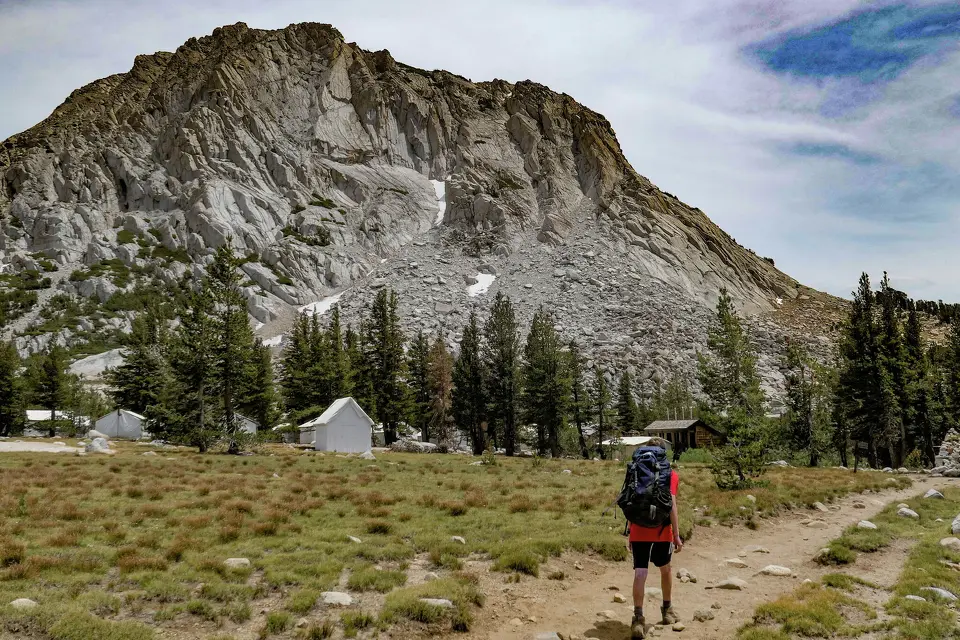
Each of the camps is in a spectacular setting — May Lake, Glen Aulin, Sunrise, Merced Lake and Vogelsang. Distances by trail between the camps vary from 1.2 to 14 miles. Each camp has canvas tent cabins. Family-style food is served for breakfast and dinner, and sack lunches for midday outings. Cots and bedding are provided. Wranglers handle logistics with pack mules. Overnight guest fees have been about $140 per person; food included. The National Park Service receives an 11.5% franchise fee.

The wilderness plan for Yosemite, part of the California Wilderness Act of 1984, allows these camps to remain in place in recognition of their historic significance, which is supported by favorable public opinion. The five camps cannot be expanded, and no new camps can be added, restrictions meant to preserve wilderness that allow ecosystems to flourish with minimum human interference; our nation’s wilderness gift from one generation to the next.
Most visitors, with wilderness permits and reservations usually won by lottery because the camps are in such high demand, leisurely hike to their chosen camp. Some chose guided mule rides. Part of the pleasure was not hauling a heavy backpack, just lunch and a bottle of water. From Tuolumne Meadows to the trailhead, the most intrepid arrange to follow a 49-mile loop over passes, past lakes, across streams and through elegant meadows framed by stunning Sierra Nevada alpine scenery, staying at least one night at each camp, a minimum six-day journey. Many, once smitten, returned repeatedly to a favorite camp or to all of them.
Trouble has been brewing at the camps for years. Beginning in 2019, heavy snows, COVID, deferred maintenance and aging infrastructure problems, potable water and sanitation challenges, and staffing shortages have caused camp closures. Although no public announcements have been made, Merced Lake and Vogelsang may not open in 2026. Merced Lake, one of the first camps, built in 1916 and consisting of 19 cabins, may be dismantled and permanently closed. Vogelsang, with 12 cabins, could be next. Questions remain about the three other camps, although they may be open this year.
The camps are operated by Aramark, the park concessioner known to be struggling with other parkwide performance issues. The park service, responsible for basic utility services at the camps, struggles, too, with recent staff layoffs and funding shortages.
In 2025, a Senate budget reconciliation bill rescinded $267 million that had been committed for park service staffing. The Trump administration budget proposal for 2026-2027 includes $736 million in cuts to park service funding, maintenance included. These huge cuts are harmful, even along wilderness trails where profit incentives and seasonal operating complexities are low priorities.
Mather believed that national parks should be accessible to all, referring to them as “national properties in which every citizen has a vested interest.” These vested public interests are being shaken to the core by politicians intent on eroding federal government services while pursuing grandiose projects and confrontations with price tags in the billions.
But some public values go far beyond price tags. Sitting by the campfire in a High Sierra Camp in Yosemite at the end of a “glorious” day quietly shared with the beauties of the natural world, as Park Ranger Ewart would describe it, is one of them. If you applaud the values of these rustic, century-old High Sierra Camps, let your senators and representatives know. In this call to action, current and future Yosemite visitors will thank you.
—
Robert Binnewies is a former superintendent of Yosemite National Park and the author of Your Yosemite, Protecting a Public Treasure.