|
Getting your Trinity Audio player ready…
|

By Glynn Wilson and Art Inverness –
The infamous decade known as the 1960s did not really begin on January 1, 1960. Like all decades and centuries, it took awhile longer for events to occur that historians would use later to define when eras began and ended.
In the case of the ’60s in 20th century America, when everything changed, it all began on a highway.
Long before the Beatles landed in America, before Woodstock, before Haight-Ashbury became a household name, a restless generation was already in motion. The road itself became a symbol of freedom, rebellion and possibility. And nowhere was that spirit more alive than in California.
The story starts with a book.

In 1957, the year I was born, Jack Kerouac published On the Road, a semi-autobiographical tale of cross-country adventures fueled by jazz, friendship, and the search for something authentic in postwar America. The novel celebrated movement instead of stability, experience instead of conformity. For thousands of young readers, Kerouac transformed the highway into a spiritual path.
The book’s destination was often California. San Francisco, in particular, became a magnet for artists, poets, musicians, and wanderers seeking a different way of life. The Beat Generation gathered in North Beach coffeehouses and bookstores, planting seeds that would later bloom into the counterculture.
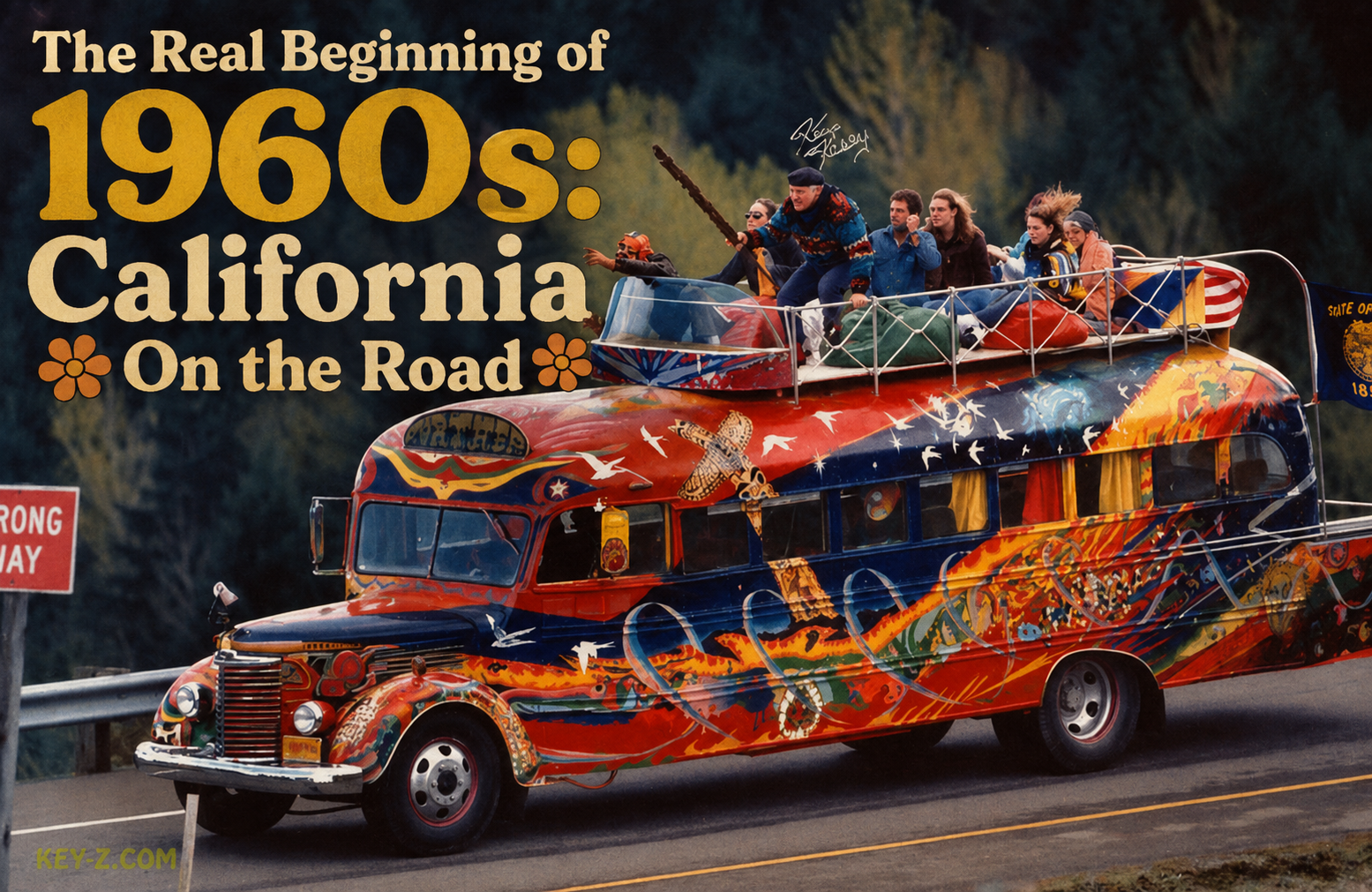
A few years later, one of Kerouac’s readers decided that reading about the road wasn’t enough. In 1964, novelist Ken Kesey and his band of Merry Pranksters climbed aboard a brightly painted school bus they named Further. Driven by Neal Cassady—the real-life inspiration for Dean Moriarty in On the Road—they embarked on a legendary cross-country journey.
The trip connected the Beat Generation to the emerging hippie movement. Kesey’s bus became a rolling experiment in freedom, creativity and communal living. Cameras rolled, music played, and boundaries blurred as the new drugs took hold, LSD. The journey itself became the destination.
When the bus returned from the Worlds Fair in New York to California, the cultural center of gravity shifted decisively westward. The state’s colleges, beaches, communes, and music venues became laboratories for a new America. In the Bay Area, Kesey’s “Acid Tests” introduced audiences to a young band that would become one of the defining musical acts of the era: The Grateful Dead.
The Dead embodied the California spirit of endless exploration. Their concerts were less performances than journeys, and their music became the soundtrack of a generation always moving toward the next horizon, fueled by drugs and a spirit of rebellion and freedom.
Years later, the band captured that restless spirit in the song Truckin’. The lyrics chronicled life on the road, the triumphs and troubles of constant travel, and the uniquely American belief that the next mile might reveal something extraordinary.
The song’s most famous line—”What a long, strange trip it’s been”—became a summary not only of the band’s experiences but of an entire cultural revolution.
Seen together, Kerouac’s novel, Kesey’s bus and the Grateful Dead’s anthem form a single story. On the Road imagined the journey. Kesey’s bus lived it. “Truckin’” remembered it.
And California was the stage upon which it all unfolded. From the Beat poets of San Francisco to the Merry Pranksters rolling down the interstate, from psychedelic gatherings in the Bay Area to the music that echoed around the world, California transformed a generation’s desire for freedom into a movement.
The real beginning of the Sixties was not a date on a calendar. It was the moment Americans started packing their bags, turning the key in the ignition, and heading west—toward California, toward possibility, and toward a long, strange trip that would change the nation forever.
__
If you like this story and independent radio service you can help Fund Yosemite Radio, KNHA 100.9 FM with GoFundMe.