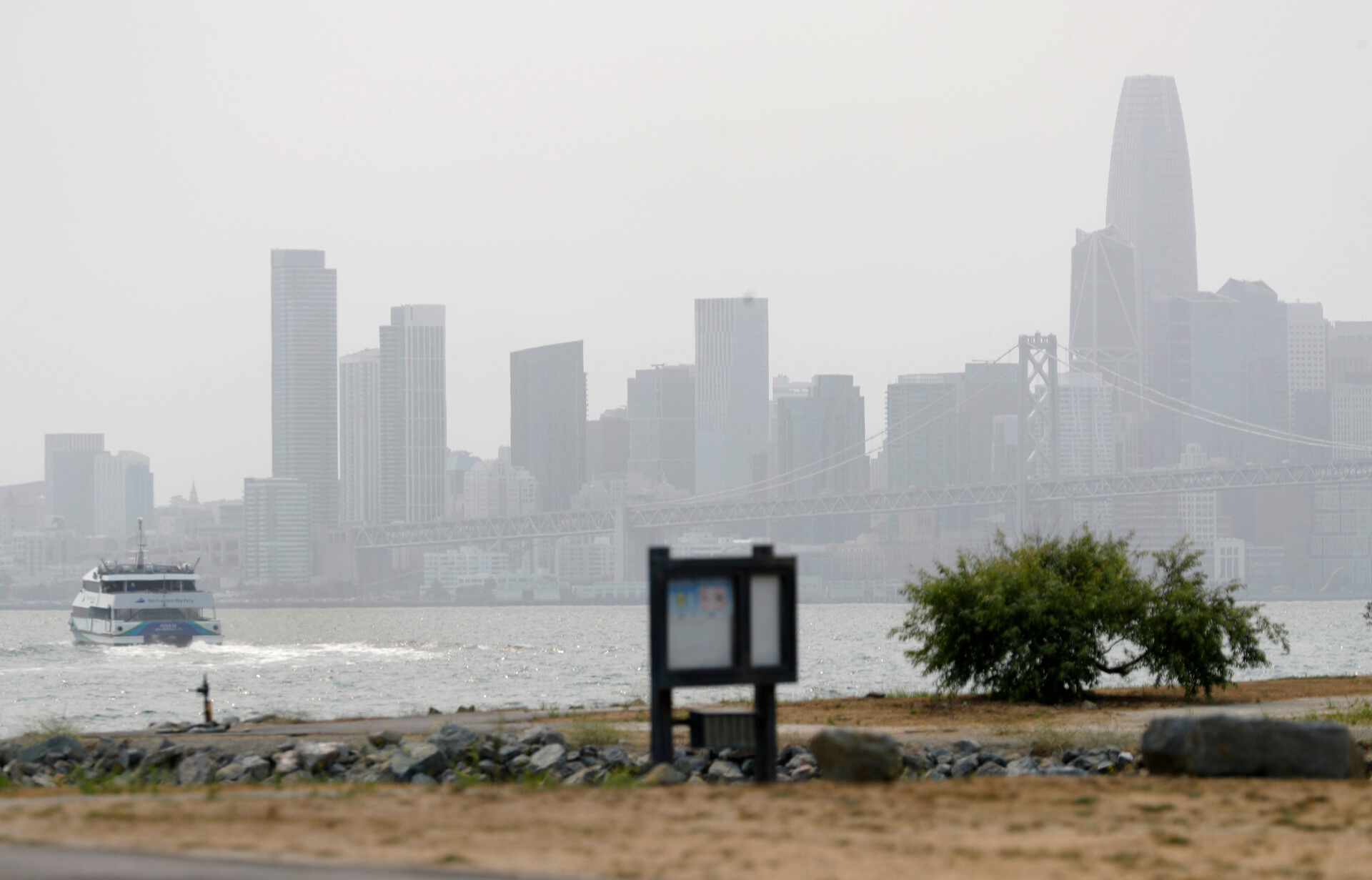
Air pollution from wildfire smoke can pose serious health risks. Here are some key steps you can take both before and during smoky days.

Staff Reporting from KQED in San Francisco –
Unhealthy air quality caused by fires has become an unfortunate reality for people around the country and the world, especially for those whose jobs or living circumstances mean they must spend most of the day outdoors. It might be tempting to try to go on with your day as normal. But the risks to your health from poor air quality due to wildfire smoke are serious and can cause long-lasting damage.
There are several ways you can protect yourself and your loved ones from hazardous air.
Why is smoke from a wildfire so dangerous to my health?
What we call “wildfire smoke” is actually an ever-changing mix of particles and gases, including carbon dioxide, water vapor, carbon monoxide, hydrocarbons and other organic chemicals, nitrogen oxides and trace minerals. Many of these compounds are toxic.
But the most dangerous thing for your health in wildfire smoke is the particulate matter: that is, the tiny pieces of soot and ash that are invisible to the naked eye. These particles are so small they’re measured in microns (0.001 millimeters) — and the most worrying particles in smoke can be less than 2.5 microns wide. For scale, a human hair is about 60 microns wide.
They’re also so light that they can travel huge distances from a raging wildfire. And when it comes to your respiratory system, these tiny traveling particles then become miniscule invaders that first cause damage to your body just by entering it, setting off inflammatory reactions that can make breathing difficult. In serious cases, these reactions can even trigger a heart attack or stroke.
The particles then travel deep into your lungs, and within a few days, the damage they cause can result in bronchitis or pneumonia.
Put simply: Even brief exposure to wildfire smoke can cause potentially serious health problems for everyone. People at higher risk include those with asthma, lung disease or heart disease, children and teens, older adults age 65+ and people who don’t live or work indoors. Pregnant people and their unborn infants are at particularly heightened risk from these particulates, which have been associated with low birth weight and premature birth for babies.
How to prepare for dangerous air quality
Since dangerously unhealthy air from wildfires can sweep in with little to no warning, it’s important to be ready beforehand. The Environmental Protection Agency, via its AirNow website, recommends taking certain steps to ensure you and your home are prepared.
Find — or make — a portable air purifier
The California Air Resources Board recommends portable mechanical air cleaners with a high-efficiency particulate air (HEPA) filter that collects very small particles and does not emit ozone or other harmful substances.
These air cleaners dramatically reduce indoor particle levels, in some cases by more than 90%. Here is a list of devices that are certified by and legal in California. If you can’t get a portable air purifier, the EPA has tips on how to make your own DIY air cleaner from a box fan and filter.
Make a ‘clean air room’ — and keep it cool
The EPA suggests designating a ‘clean air room’ in your home, one you can quickly seal off from any outside air and in which you can run a portable clean air filter. If excessive heat is a concern where you live, and you have a room with an air conditioner, this room might be best to select — just be sure to keep the fresh-air intake closed on any air conditioners to prevent outdoor smoke from getting inside. If it’s not feasible to designate a single clean air room, consider purchasing multiple portable air purifiers and ensure your home is properly sealed to outside air.
During heat waves, pay attention to temperature forecasts and know how to stay safe in the heat. Even if you don’t have air conditioning, keep doors and windows closed. This can reduce pollutant levels by 50%, according to the EPA. If you can’t stay cool at home or at a friend or relative’s house, the EPA suggests seeking relief at a clean air shelter or other large building with air conditioning and good filtration.
Stock up on filters for your air purifiers now
Whether for portable air purifiers or a central HVAC system (if you have one), it’s a good idea to stock up on replacement air filters before the need arises. If you wait until smoky air descends, the EPA warns, supplies may be out of stock or may not arrive in time to be helpful.
If you’re using a central HVAC system, make sure to purchase high-efficiency filters rated MERV-13 or higher.
Have masks ready to wear
As for what kind of masks offer the best protection against wildfire smoke, the answer is still: that collection of N95 or KN95 masks you may have stocked up on due to COVID. If you don’t have any left, now is a good time to stock up.
As for N95 masks with exhalation valves, it’s worth noting that these masks work well for wildfire smoke and may be easier to breathe through longer-term. But they’re less effective at stopping the spread of diseases like COVID — even with tape over the valve.
The least effective options are one‐strap paper dust masks or surgical masks that hook around your ears — they don’t protect against inhaling fine particles. Note that a cloth mask will not adequately protect your lungs from particles found in wildfire smoke, either.
Check your local air quality

Bookmark our real-time Bay Area air quality map, which includes data from official EPA AirNow sensors, as well as from dozens of low-cost private sensors manufactured by PurpleAir. There are a few points to keep in mind if you’re noticing discrepancies between what those sensors are reporting. Keep a close eye on local air quality reports to gauge how much time is safe for you and your family to spend outside.
The air quality index (AQI) is divided into six categories, each corresponding to a different level of health concern. (Courtesy EPA)
When the air quality index (AQI) rises to 101 or above, consider taking steps to reduce exposure.
Keep your indoor area purified
Make sure all doors and windows are closed and turn on those portable air purifiers, or crank your central HVAC system with a MERV-13 or higher-rated filter, if you have one. If you’re running an air conditioner, keep the fresh-air intake closed to prevent outdoor smoke from getting inside.
Leave your portable air cleaners running continuously and avoid activities that increase indoor pollution. Burning candles, cooking on gas stoves and vacuuming can all increase indoor pollution.
Driving? Don’t let smoke inside your car
The Bay Area Air District recommends that on smoky days, you use the “recirculating air” button in your car’s air conditioning system, if you have one (it’s the button with the symbol of a car with a looping arrow inside it).
When your recirculating air is on, your car will stop taking in any air from the outside — and instead, your AC will recirculate the air that’s already inside your car. This will help prevent smoke outside from entering your car while still keeping the inside of your car cool.
Help the smoke leave your body
If you’ve been exposed to wildfire smoke, wash your nose out and gargle with clean water. Do this five times a day until the smoke subsides. Take a shower and wash your clothing after being outside, even if your clothes don’t smell particularly smoky.
Keep pets inside
Whether house pets or livestock, domestic animals are affected by wildfire smoke, too. During periods of poor air quality, try to limit their time outside as much as possible.
__
If you like this story and independent radio news service you can help Fund Yosemite Radio, KNHA 100.9 FM with GoFundMe.