San José leaders residents organize against them –
By Joseph Geha

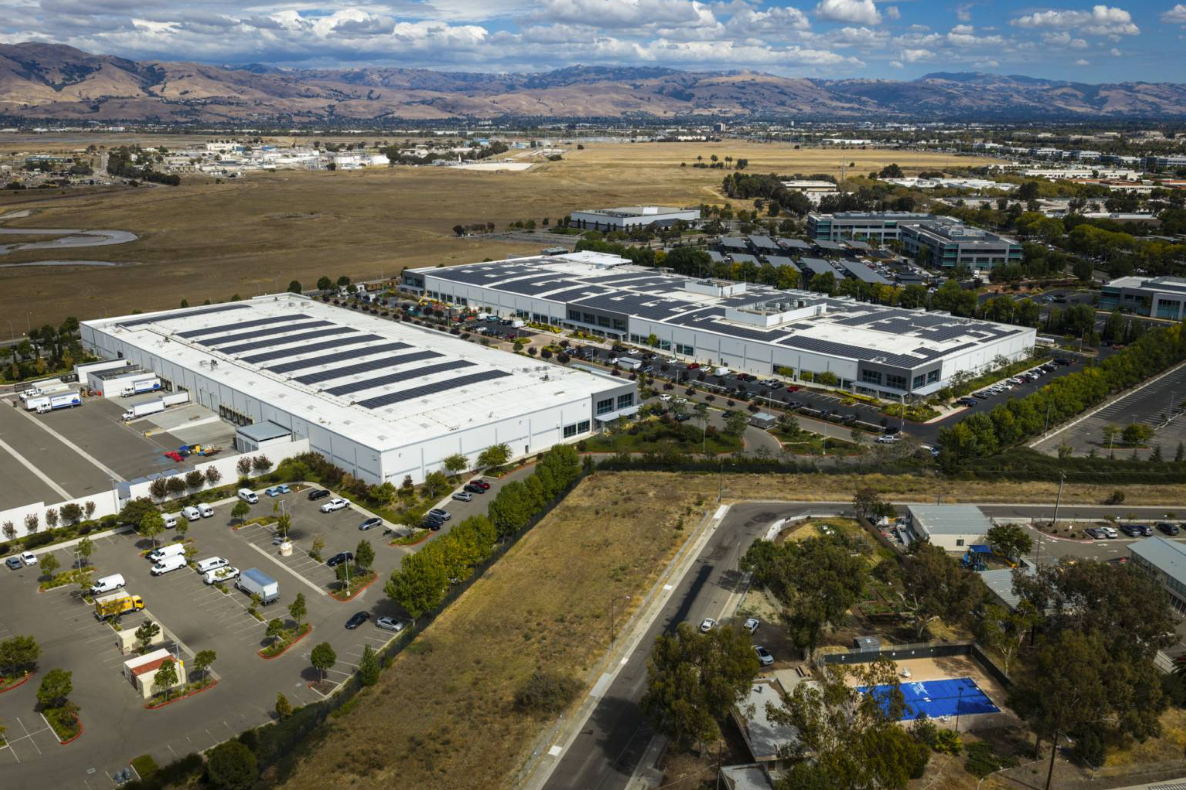
Ken Thompson stands outside of a lot on Silver Creek Valley Road in south San José, which is intended to house a data center, on Sept. 3, 2026. (Martin do Nascimento/KQED)
Santa Clara has quietly become California’s data center capital. The sleepy suburb known for its quiet streets and professional football stadium is home to 60 data centers — more than any other city on the West Coast, according to reporting from KQED in San Francisco.
Cheap electricity sold by the city’s own power company has for years attracted major tech firms and data center developers seeking millions of dollars in savings over PG&E rates as they build out the hulking, cube-like structures full of computers, networking and cooling equipment. The city and its planners have also made it easy on developers seeking guidance and approvals, which are largely handled by the city’s planning commission.
But now some local lawmakers are raising concerns. Kevin Park, a council member and tech worker who is running for mayor, said the city has gone too far, as the power company’s supply is strained and it has raised rates on residents to pay for major infrastructure upgrades.
“Let’s stop building data centers. And the water and the electricity and all the things that we’ll save, let’s use them for other things,” he said.
As the current artificial intelligence boom fuels rising demand for data centers in Silicon Valley, concern about their effects on the environment, resources and surrounding communities has burst into public discourse and turned the issue into a political hot potato. Local lawmakers are now scrambling to weigh constituents’ concerns against the prospect of embracing the economic windfall proponents say data centers can bring.
While South Bay cities have so far not enacted temporary moratoriums like the one-year ban Oakley in the East Bay recently passed, some places, like Gilroy, have tightened data center approvals amid pushback to the massive buildings seemingly rising overnight. Statewide polling suggests most residents oppose building data centers to support the AI industry in their area.
Even in a city like Santa Clara, which has long leaned on data centers as a driver of revenue, some politicians, like Park, are calling for a halt.
“If we took down a single mid-size data center using 20 to 40 megawatts of power, we could actually double the population of the city and not need a single additional watt of power,” Park said.
The city, which has about 130,000 residents, is also home to tech behemoths like Nvidia, whose advanced processing units and software are at the center of the AI race and data center growth. “I don’t think people understand that’s the scale we’re talking about. Every large data center we put in can use the entire electric capacity of a city,” he said. “This is something we need to think about.”
But lawmakers in neighboring San José are taking a different approach from what Park is proposing, leaning into the AI industry’s demand for larger, more energy-intensive data centers even as they try to assuage residents’ concerns.
Related Article
 Oakland Residents Continue Push Against Data Centers
San José, with nearly 1 million residents, has for more than a year been actively courting data center development, hoping to provide a stable injection of property and utility taxes into city coffers. Officials say the city, historically a sprawling bedroom community that struggled to generate commercial revenue, currently has about 20 operating data centers. The projects require a special use permit, which must be approved by the city’s planning director at a public hearing. But a planning commission or City Council meeting is not required.
Last summer, San José Mayor Matt Mahan announced a deal with PG&E that would guarantee power availability and quick connections for 10 major projects in the coming years. In a statement, the city said the pact would position San José as the “West Coast’s premier destination for data center development.”
The city launched “concierge-style support” for data center developers, made dozens of individual pitches and participated in industry events and conferences, leading to a near doubling of interest in data center development in the city by earlier this year, staff reports say.
But the city’s efforts to go all-in on data centers and other large energy-use projects have prompted fierce pushback.
“I think we’re in a full-on backlash against the buildout of the data centers, and not just in California, but in the country and really worldwide,” said Irina Raicu, the director of the Internet Ethics Program at the Markkula Center for Applied Ethics at Santa Clara University.
“In part because of the trade-offs that these buildings require, in part because of lack of information and the way people have been surprised in so many places by the apparition of these big centers,” she said.

In North San José’s small Alviso neighborhood, a historically underserved portion of the city that has been heavily developed with tech campuses, corporate offices and research facilities, officials are expecting the buildout of at least three major data centers and large energy-use projects.
Google is proposing to demolish an existing warehouse and build research and development facilities expected to draw about 250 megawatts of power.
“For context, 250 MW is larger than the average demand of all of Marin County in 2024, and about half the overall average demand of San Mateo County,” the California Public Utilities Commission said in its review of the project.
Not far away, Microsoft is already building a 99-megawatt data center with 224 natural gas generators to provide continual power when there are outages or the grid is overloaded.
And on 159 acres of land used as a buffer between a wastewater facility jointly owned by San José and Santa Clara, the city has entered into an exclusive negotiating agreement with Prologis, which is proposing a facility that in total would use 496 megawatts of electricity across data centers and research facilities.

Based on those power estimates, the group of Alviso facilities at full capacity could use more energy daily than the entire city of Santa Clara — with its dozens of data centers — currently does, said San José resident Ellina Yin, who has tracked data center development closely.
“So we’re putting an entire city’s worth of data centers in this tiny neighborhood, and the public health implications are unstudied. We don’t really understand what the future impacts could be,” she said.
A community listening session in San José last month turned out hundreds of people, most expressing concern about data centers and some calling for a moratorium on accepting applications from developers.
Mahan, a former tech worker, has said in the past that rejecting data center development outright would be akin to burying “our heads in the sand.”
Some residents said they sense a disconnect between what people are telling elected leaders and what policies are being advanced.

“They don’t seem to care about the fact that a lot of people just really don’t want this in their backyard,” said Ken Thompson, a South San José resident who lives steps away from a proposed data center. “If the community doesn’t want it, if the local area around it doesn’t want it, then why are we forcing it upon them?”
Mahan doesn’t see it that way. Instead, the city has taken a build-the-airplane-while-flying-it approach, holding community meetings to gather feedback that will inform a planned beefing up of regulations and standards for data center proposals.
“We’re going to set, with input from the community over the coming months, some of the highest, strictest standards in every category of concern we’ve heard,” Mahan said in an interview. “Labor standards, environmental protection, rate-payer protection, aesthetics and other community engagement and community benefits.”
City officials expect to present the City Council with the new standards by the end of the year.
“It is much more important that we regulate Big Tech to get this right than to simply say ‘no’ and make it somebody else’s problem and lose the ability to shape this investment,” Mahan said.

Meanwhile, business and industry trade groups representing the biggest tech companies and data center developers say data centers are paramount to the success of the digital economy, Silicon Valley’s continued status as an innovation engine and American dominance in AI technologies.
“If California is not positioned to continue rapidly deploying and scaling AI technology … if our state general fund, if our local community economies are not able to garner the benefits of this, it will go elsewhere,” said Ahmad Thomas, the CEO of Silicon Valley Leadership Group.
“I think the next 30 to 40 years of economic supremacy globally is going to be determined by who gets this right,” he said.
Thomas said the data centers proposed in the Silicon Valley region are being developed responsibly, making use of renewable energy, recycled water, and offering community benefits. He said it’s a template all data center development should follow, and might assuage some concerns and fears.
“Our thesis is that listening to the community leads to better innovation. That has always been our working approach,” he said.

Khara Boender, a spokesperson for the western division of the industry trade group Data Center Coalition, said data center backers want to be good neighbors.
“The industry is committed to paying for its full cost of service for electricity and the underlying infrastructure that it uses,” Boender said. “The industry is committed to responsible water use, and has made different investments in restoration and replenishment projects.”
The buildings, which as recently as several years ago were much smaller and drew significantly smaller energy loads, were previously primarily used to house and exchange information across the internet, and later came to support all kinds of daily needs of a modern world, like social media, streaming services and video communication services for meetings and telehealth.
“They support the very fabric of our digital lives and every aspect of that,” said Dr. Andrew Chien, a professor of computer science at the University of Chicago.
But newer data centers are packed with high-energy processing and computing elements that are increasingly used for AI, both to do the complex computational work needed to power AI chatbots and agents, and to train massive AI models and systems that are at the forefront of the technology.
Related Article
 Chatbots, Data Centers and Surveillance: 5 Silicon Valley Bills Land on Newsom’s Desk
Chien said because AI is a fundamentally different way to deliver services, it has drastically increased the need for data centers.
“Traditionally with computing, a service like email or like social media, it’s mostly taking a piece of digital data and serving it up or maybe organizing a little bit and then serving it up. But when you talk to a chatbot, or you ask Claude to go do some complicated analysis or Gemini or ChatGPT, you actually trigger a gigantic number of numerical computations,” Chien said. “So there’s dramatically more energy required to do that. So it’s not only the growth of AI, it’s the fact that AI is a hugely energy-intensive way of delivering this intelligence.”
The rapid growth of data center proposals and industry bullishness have been met with growing grassroots resistance in Silicon Valley, led in part by Yin, the San José resident. One major factor fueling the resistance is a striking lack of clear information about how much power, water and other resources data centers use.
Yin said the financial and technological imperatives espoused by data center proponents shouldn’t trump the need for updated regulations and deeper understanding about the long-term, cumulative impacts across the region on things like air and water, which take time to develop.
“The scale that we’re seeing them be built out nationally is just, it’s overwhelming. I’ve never seen anything like it in my lifetime. And I feel like there’s just a lack of due diligence that we cannot repeat from previous generations,” Yin said.
“They are leaving that to the burden of future generations to deal with, just as when cell phones came, and we didn’t understand social media, and now look at the state of child development and the impact of social media on the youth,” she said.
She pointed to the collection of Superfund polluted sites across Santa Clara County, created by years of toxic material mismanagement in the semiconductor industry that flourished there decades ago, or the global plastics industry.

“We didn’t know any better. And now it’s in our bodies, it’s in our water, and the plastics industry did not come running to save us and to do all the reparations of correcting the damage that they caused. And so I don’t think I can trust that the AI industry is going to come and do the reparation of the impacts that they’re going to cause,” she said.
Raicu, the director of the Internet Ethics Center, co-authored a report on data centers and water use, and said the overall lack of clear information about the resource consumption of data centers by the companies proposing and operating them is striking, and more disclosure should be required.
Some reports, like one out of Virginia, which has the highest concentration of data centers in the country, say many there use as much water as large office buildings each year, between 4 million gallons and 10 million gallons. But others use far more, including one that uses 243 million gallons. The picture both locally and nationally isn’t always clear or comprehensive, Raicu said.
“We don’t know how much energy and how much water data centers are using. And the demands are going to be different at the scale that we’re talking about for these new kinds of data centers,” she said, noting that researchers have advocated for more detailed information.
“The fact that it’s been such a multi-year battle in which only now are some companies voluntarily starting to disclose, data center by data center, what’s actually being used, that’s a big reason we’re seeing the pushback and the distrust,” she said.

Gov. Gavin Newsom vetoed a bill last year that would have required water use disclosure by data center developers, and has another similar bill on his desk this year, along with a raft of other bills aimed at drawing more information from data center proponents and protecting electricity customers from paying higher rates in connection with them.
Thompson, the South San José resident, who lives in a small house on a former orchard, said he initially got involved in the push against data centers when he found out one could rise just steps from his home.
Prologis is proposing a three-story, 99-megawatt data center that would include 44 diesel generators for backup power on Silver Creek Valley Road.
Thompson said city officials told him current air quality regulations would limit the number of hours per year the center would be allowed to operate the generators, which produce toxic compounds when running during power outages.
“But if the penalty for [exceeding] that is a fine, then I have a sneaking suspicion that that’s not going to stop them … because the money that they make is going to be more than the fine,” Thompson said.
Related Article
 San José Leaders Eying More Multifamily Homes in Single-Family Neighborhoods
The proposed site is next to a hiking trail and a city park, and less than a quarter-mile east of single-family home neighborhoods.
Thompson said he opposes this data center and others like it because of the potential diesel emissions and the constant low-frequency sounds they can emit that he worries could harm people or wildlife in the area next to Coyote Creek and the foothills. He’s also concerned about a more AI-driven world threatening workers and art, and perpetuating surveillance technology like the license plate readers mounted all over the city.
He participated in the community listening session and a small-group discussion facilitated by the city recently.
“One of the things I found most interesting was they were also focusing on the fact that old data centers used to be just these hideous boxes and we’re going to try and regulate them to be more beautiful,” Thompson said.
“The funny thing to me is, it doesn’t matter to me what the color of the gun that’s pointed to my head is going to be,” he said.
Raicu thinks holistic conversations about how data centers are built, where they make sense and how they affect society need to be top priorities.
“None of this is just a force of nature. These are decisions made by human beings. Regulations can be passed. There can be a lot more money spent on making more sustainable technology. There could be delays put in place as to whether you deploy something at this kind of scale,” she said. “All of that is just human decisions.”
KQED Correspondent Guy Marzorati contributed to this story.
__
If you like this story and independent radio news service you can help Fund Yosemite Radio, KNHA 100.9 FM with GoFundMe.
Leave a Reply