Tales From the MoJo Road –
By Glynn Wilson –
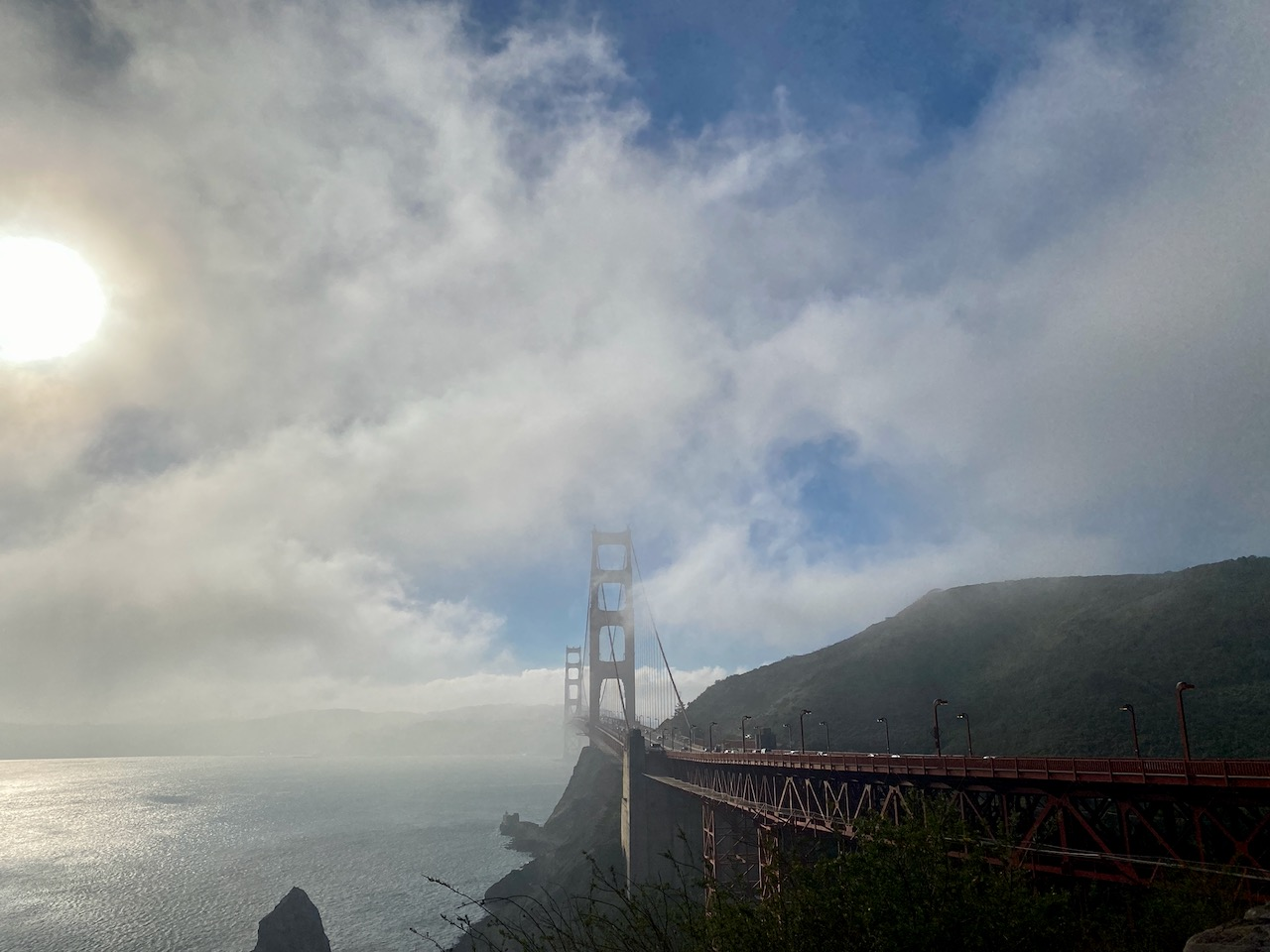
SAN FRANCISCO, Calif. – From the Golden Gate Bridge crossing San Francisco Bay to Apple’s iconic round “Spaceship” campus in Cupertino near San Jose, there lies an ideal place in the universe that embodies the American Dream in the 21st century.
Driving north from San Jose on Interstate 101 on Wednesday, finally emerging from an unusual fog that has covered the area of late, the sun came out as I scanned the radio airwaves for rock stations. Just as San Francisco Bay came into view, I heard a choir singing a Rolling Stones song, “You can’t always get what you want, but if you try sometimes, you just might get what you need.”
It was the perfect song to capture the moment, so I turned it up and drove into the city for the first time.
It was American journalist Donald C. Hoefler who first used the term “Silicon Valley” in a news story for the Electronic News on January 11, 1971.

The region in Northern California became the global center for high technology and innovation in the last couple of decades of the 20th century and led the country and the world into the 21st century. It basically encompasses the area bordering San Francisco Bay on the west, corresponding roughly to the geographical area of the Santa Clara Valley.
It also serves as a general metonym for California’s high-tech business sector and includes the cities of Sunnyvale, Mountain View, Palo Alto, Menlo Park, Santa Clara, Redwood City and Cupertino all the way south of the bay to San Jose. The Metropolitan Statistical Area has the third-highest Gross Domestic Product per capita in the world next to Zurich, Switzerland and Oslo, Norway. It has the highest percentage of homes valued at $1 million or more in the U.S.
Silicon Valley is home to many of the world’s largest high-tech corporations, including the headquarters of more than 30 businesses in the Fortune 1000, along with thousands of startup companies. It accounts for one-third of all of the venture capital investment in the country, which has helped it to become a leading hub and startup ecosystem for high-tech innovation. It was in Silicon Valley that the silicon-based integrated circuit, the microprocessor and the personal microcomputer were developed that led to the technological development in the 1990s, resulting in the Dot Com Boom and busted bubble at the turn of the century in the year 2000.
The A.I. Bubble Will Also Go Bust
While figures show that by 2021 the region of Silicon Valley employed about a half million information technology workers, and became a hotspot for tech tourism as well, things have taken a bit of a nose dive of late as the Artificial Intelligence boom (or bubble) has led to massive layoffs and a rethinking of the American Dream itself. Will A.I. bots end up running everything? How will people stay alive and make a living?
Many workers in the area have been affected by layoffs in the aftermath of what has been euphemistically called a period of “overhiring” during the Covid pandemic. U.S. tech companies have announced roughly 154,000 layoffs in the past couple of years. The big tech giants Microsoft, Amazon, Meta, Google and Tesla all announced cuts of up to 10,000 employees.
Even the Gen Z kids who went to college to learn to be hackers and code programmers are finding it hard to find and keep jobs already. The bots are on the verge of typing all the code themselves
Google Empire Will Be Tested
Every company would be affected if the A.I. bubble were to burst, Sundar Pichai, the head of Google’s parent company Alphabet, admitted in a recent interview with the BBC.
Pichai said while the growth of Artificial Intelligence (A.I.) investment had been an “extraordinary moment,” there was some “irrationality” in the A.I. boom. It comes amid fears in Silicon Valley and beyond of a bubble as the value of A.I. tech companies has soared in recent months and companies spend big on the burgeoning industry.
Asked whether Google would be immune to the impact of the A.I. bubble bursting, Pichai said the tech giant could weather that potential storm, he thinks, but he also issued a warning.
“I think no company is going to be immune, including us,” he said.
He’s also worried about the energy needs for A.I. data centers, throwing the fight against climate change into chaos, as well as the accuracy of his A.I. models and the effect of the A.I. revolution on jobs.
As valuations rise, some analysts have expressed skepticism about a complicated web of trillion dollar deals being done around OpenAI, which is expected to have revenues this year of less than one thousandth of the planned investment. There is no way that is sustainable.
“It has raised fears stock markets are heading for a repeat of the dotcom boom and bust of the late 1990s,” says the BBC. “This saw the values of early internet companies surge amid a wave of optimism for what was then a new technology, before the bubble burst in early 2000 and many share prices collapsed.”
This led to some companies going bust, resulting in massive job losses. A drop in share prices can also hit the value of people’s savings, including their pension funds.
Do You Know the Way to San Jose?
We will be spending more time in San Francisco looking into this story in the weeks ahead. But as I was heading back south toward San Jose, another song caught my attention on the radio dial.
“Do You Know the Way to San Jose” is a 1968 popular song written and composed for singer Dionne Warwick by Burt Bacharach.
Here’s another iconic song about San Francisco.
There is more to come in this series investigating what’s happening in the economy of the U.S. and California, so check back soon for more.
To read the full story, check it out in the New American Journal.