“You are entitled to your opinion. But you are not entitled to your own facts.”
― Daniel Patrick Moynihan
The Big Picture –
By Glynn Wilson –
COULTERVILLE, Calif. – At the risk of boring you to death, or worse, alienating you beyond repair, I’m going to say a few things you need to hear – whether you like it or not.
What this town needs, what this county needs, what this state needs, indeed what this country needs, is an objective observer to report facts.
What is definitely NOT needed is another biased talking head podcaster/influencer, or for that matter an ill-trained bot, filling up the public airwaves and social media with opinionated gossip and garbage.
Perhaps you’ve heard the saying developed during the early computing era.
“Garbage in, garbage out.”
This is a concept describing what happens when flawed, biased or poor quality (garbage) information or “input” produces a result or “output” of similar (“garbage”) quality.
For anyone born after the year 2000, your entire lives are corrupted by this garbage, and I’m sure you’ve never heard of Daniel Patrick Moynihan.
For those left alive of the World War II generation, and all of us Baby Boomers born after the big war, we recall Moynihan from television and are familiar with the concept.
How can we explain it to make it simple for any person reading on the fifth grade level might understand? Think of this: Newspaper editors in the 20th century often hired young reporters to cover the news for two reasons: Number one they worked cheap. Number two they had not formed firm political editorial opinions yet, so they were seen as “objective.”
Once a reporter works at covering politics for a time, he or she might form opinions, take a side, and thus become editorial columnists – or worse, one-sided pundits on television.
Cable television and social media are totally polluted by this now, as news corporations decided long ago that the partisan divide was hopeless. So better to profit from catering to public biases. This first started appearing on CNN with the show “Crossfire,” which was canceled after comedian Jon Stewart accused the cast, including arth-conservative Pat Buchanan, of damaging democracy.
I am human. I am old. And yes, as I watched the partisan divide tear apart our country over the past few decades, I chose a side. The side that was still reachable by the written word on the web, not the biased, selfish shouting on cable TV and social media.
But here, for the purpose of analyzing what this place needs, I am new – and therefore an objective observer. By the end of September I will have been here observing things for one year.
There are some here who do not believe this is what’s needed. They seem to want to trust only someone who was born and raised here, and long ago decided what side of the political street they are on.
If you feel you need to ignore the messenger, or shoot the messenger, go ahead. I came to California to retire and to eventually die. There’s no going back for me, as I recently wrote when I rewrote the lyrics to the Led Zeppelin song, “Going to California.”
Making It to California
Spent my days in a region of fear
Smoked my stuff and drank all the good beer
Made up my mind to make a new start
Going to California looking for peace in my heart
Someone told me there are girls out here
With kindness in their eyes and flowers in their hair
Took my chances across the country in a van
It’s a beautiful place all the way from Maryland
Oh, the Pacific was green and the sky was blue
Wonder how tomorrow could ever follow this golden hue
Then the trees in the forests started to burn
The people of the sun begin to run (watch out)
It seems the wrath of the gods came down from on high
The world started to glow and the end may be nigh
Throw me a line oh goddess, and if I reach it in time
I’ll meet you up there on the mountain where the path runs high
Looking here and there for a queen with no king
They say she plays guitar and sings like a dream
Road a white van into the forest at dawn
Tryin’ to find a woman who’s never, ever been born
Climbed a rise in the Sierra mountains of lore
Tellin’ myself it’s not as hard, hard as it seems
But it is, oh it is, as hard as it seems
There’s no way back, so I must go on, and on…
We will soon put that to music.
I’m ready for whatever comes in any event. I agree with Mark Twain, who once wrote that he was not so happy with the 20th century as he was in the 19th.
Having lived my first 43 years in the 20th century, and only the last 25 in the 21st, I will take the 20th century any day, even though I’ve had a great run writing for the web press.
Living in a country run by a right-wing mob boss dictator-king who wants to be a Roman emperor and in a world on the verge of being run by A.I. bots does not particularly appeal to me.
The Trump Dividend and the Bribe of Gold by Roman Emperor Commodus as the Roman Empire Falls
The Press: Raising a Red Flag When Riptides Churn Society
But as long as I’m still here, feeling good and having some fun, I still have a few things to say – without fear or favor and the consequences be damned. Writers write.
One
For starters, I’ve found myself in several conversations of late quoting an economic principle I learned a long time ago studying economics. An economic game theory called the Nash Equilibrium.
If you want to create a successful town, for example, stop worrying about competing with each other and realize that the more businesses operating in a town the better business will be for them all.

Why Burger King Is Always Next to McDonald’s, and What It Teaches Us About Modern Marketing
By Katie Middleton
Marketers were once trained to isolate and were taught to buy a billboard, run a radio ad, dominate your niche, and keep the competition out.
But today?
Collaboration outperforms isolation.
If you’ve ever driven through a certain part of town and noticed a Burger King sitting directly across the street from a McDonald’s, you might have thought it was just a competitive duel of the fast-food burger.
But it’s not. It’s strategy.
Sure, there are food preferences, and people talk about who makes the better fries, but it goes much deeper than that.
It’s about visibility, competition, and a game theory concept called the Nash Equilibrium.
Named after mathematician John Nash, it describes a situation that occurs when competing players settle into positions where neither gains by changing their strategy unless the other does too.
So, why would two major competitors like McDonald’s and Burger King choose to set up shop side by side?
Because moving away won’t make them more unique. They would risk losing visibility and market share.
Burger King isn’t banking on you only wanting a Whopper. They’re betting that being near the crowd gives them a slice of the foot traffic, the impulse decisions, and the convenience factor.
It’s better to compete where the customers already are than to be totally alone in a quiet corner of town.
This tactic isn’t limited to fast food.
Retailers often cluster similar stores together.
Hospitals compete for patients in the same zip codes.
Cereal aisles are packed with competing brands, all in the same 6-foot stretch of shelf space.
Car dealerships often cluster in auto rows.
Coffee shops open next to each other on every corner in a major city.
The idea is to be where the customers are, even if it means being near competitors.
Why?
Because showing up next to competition doesn’t dilute your brand. It validates it.
It signals to customers that this is the place to look for what you want.
And now, the same game is playing out online with content creators and brands.
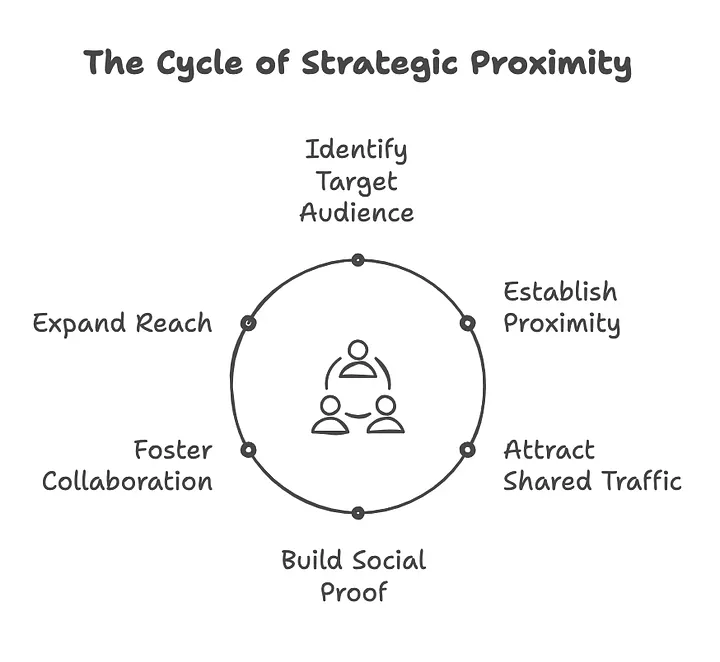
Instead of isolating themselves and trying to tackle growing a following alone, they use the same concept.
Look at what’s happening across platforms:
Streamers on Twitch and YouTube co-host events, chat in each others streams, and play the same games on the same night.
Influencers do podcast swaps, tag each other in posts, and appear in each other’s stories.
Business owners cross-promote newsletters, write guest posts, and do events together.
They’re no longer avoiding competition. They’re leaning into proximity.
It gives a whole new meaning to, “You are who you surround yourself with.”
When an audience already trusts someone, and you show up right alongside them, you borrow that trust and become part of the ecosystem.
Even major brands use this strategy like Nike x Tiffany & Co. and Starbucks x Stanley Cup.
These collaborations leverage audience overlap, building trust and expanding reach.
“Wait! But Isn’t That… Copying?”
This is a fear many entrepreneurs face, “If I talk about what everyone else is talking about, won’t I just blend in, do I look like i’m trying to be like everyone else?”
And the simple answer is…No.
Not if you do it with your own voice, your own spin, your own story.
Because proximity doesn’t mean plagiarism. It means relevance.
If someone else in your industry is already succeeding on a platform, a topic, or a trend, that doesn’t mean you’re too late.
And really, if you’re the only one out in left field, chances are no one’s even looking in your direction.
What This Means for You
The bottom line is this…
You don’t need to reinvent the wheel.
You don’t need to carve out a totally untouched corner of the internet.
You don’t need to wait for someone to discover you in isolation.
You need to
Show up where the conversations are already happening.
Collaborate instead of compete.
Speak on the same topics with your own clarity, personality, and insights.
Understand that attention is a shared resource.
The goal isn’t to be the only voice. The goal is to be a trusted voice.
You don’t need to fear competition or strive to create something entirely unique.
If you’re growing a brand, building a following, or just trying to reach the right audience and feeling discouraged because someone else is already talking about your niche, remember this…
McDonald’s doesn’t need to move for Burger King to succeed.
And neither do you.
You’re not too late.
You’re not too similar.
You’re just one strategic step away from being seen.
Go where the customers already are. Join the conversation and claim your spot in!
Don’t fear the crowd. Find where they’re already looking.
Here, what is needed is more businesses bringing more people to the original John Muir route to Yosemite, which will help us all.
Why Burger King Is Always Next to McDonald’s, and What It Teaches Us About Modern Marketing
Two
What is needed everywhere is more altruism and less selfishness and petty, personal competition.
This is what our nonprofit organization is all about.
Operation New Earth Posts New Website
Three
The goal here should be to reach out on the web and help more people understand that the original John Muir route to Yosemite is the best one, and get more people coming this way. Every business would benefit from that. The more things to do and see here, the better our chances of success.
So stop trying to stop competition and stifle other peoples’ ideas. This just creates more bad blood and further divides communities.
Four
Think about this. If you tell someone to their face that you are not interested in their pages, posts or opinions, what do you think the human response will be? They will not be interested in your pages, posts or opinions either. Don’t be selfish. Think altruistically if you expect to succeed.
Sign up for the Altruism Pledge to Make the World a Better Place
__
If you like this story and independent radio news service you can help Fund Yosemite Radio, KNHA 100.9 FM with GoFundMe.

Leave a Reply