|
Getting your Trinity Audio player ready…
|
Staff Report –
It has come to our attention that Mariposa County District 2 Supervisor Shannon Poe has lost his final appeal for polluting the Clearwater River in Idaho and is subject to a $150,000 fine.
Poe was sued in Idaho for his suction dredge mining operation on the South Fork of the Clearwater in Idaho and the courts found him to be in violation of the Clean Water Act after the Idaho Conservation League brought a lawsuit, according to reporting from the Idaho Capital Sun.
A 10-year battle to hold the California gold miner responsible for violating the Clean Water Act in Idaho by repeatedly dumping suction mining waste into the South Fork of the Clearwater without a permit is over. The U.S. Supreme Court declined to hear a petition to review a lower court ruling finding that Poe violated the Clean Water Act at least 42 times since 2014 by dredge mining without obtaining a National Pollutant Discharge Elimination System permit.
By not reviewing his case, the U.S. Supreme Court left in place the lower court rulings, confirmed Laird Lucas, executive director of Advocates for the West.
The Idaho Conservation League and the law firm Advocates for the West, both of which are Boise-based nonprofit organizations, spent a decade documenting Poe’s dredge mining activities and then steering the case through the court system.
“We’re very encouraged; we’re happy to see the Supreme Court reject Poe’s argument and settle this matter once and for all,” said Jonathan Oppenheimer, government relations director for the Idaho Conservation League, in a phone interview. “It sends a strong message to others who would want to take a chance to dredge mine without the proper permits that they will have to pay a hefty price. (Poe) is facing a $150,000 fine, which he has already started paying.”
Efforts to reach Poe through the Pacific Legal Foundation, which represented him in court, were unsuccessful.
However, Frank Garrison, one of the Pacific Legal Foundation attorneys on the case, issued a written statement to the Sun on Friday.
“We are disappointed the Court decided not to grant Mr. Poe’s petition,” Garrison wrote. “The Ninth Circuit in this case reflectively deferred to a previous (Environmental Protection Agency) interpretation of the Clean Water Act, which would now be in direct conflict with the Court’s decision in Loper Bright.”
“Despite this setback, we will continue to fight against executive agencies‘ overreach, both in the Ninth Circuit and throughout the Country,” Garrison added.
How did a California gold miner pollute a river in Idaho?

Idaho Conservation League staffers learned about Poe after he participated in and posted online about a 2014 “Occupy the Water” suction dredge mining event on the Salmon River in Riggins that was held in opposition to Environmental Protection Agency regulations, court documents show.
The Idaho Conservation League notified the Idaho Department of Environmental Quality and the Environmental Protection Agency of Poe’s alleged violations, court documents show. When the state and feds didn’t step in, the Idaho Conservation League brought a citizens’ enforcement lawsuit against Poe in 2018.
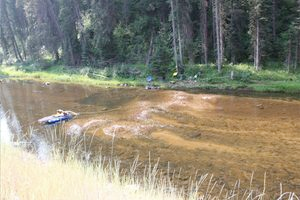
Poe continued to post online about his intent to dredge in Idaho in opposition to EPA regulations and encouraged others to join him, court records show. After Poe would send out an online post, Idaho Conservation League staff and contractors would head out to Idaho Highway 14 and watch for Poe on the South Fork of the Clearwater River. The Idaho Conservation League submitted numerous photos of Poe’s dredge operation on the river alongside the relevant archived social media posts from Poe as part of the conservation organization’s citizens’ enforcement suit against Poe.
“He was someone who was relatively easy to keep an eye on because he would announce his intention to come up and violate the law and then tell you where he was going to do it,” Oppenheimer said. “Effectively he was inviting someone, whether it was the Forest Service, EPA, DEQ or, in this case, ICL, to come up and enforce this.”
Poe often wrote about dredging in Idaho, court records show.
“Shortly after the Occupy event, (which Poe’s organization the American Mining Rights Association attend), we packed up our two dredges… and headed for our claim about an hour away on the South Fork of the Clearwater to dredge openly in opposition to the EPA,” Poe wrote in one online post, court records indicate.
Poe’s legal team at Pacific Legal Foundation argued that suction dredge mining isn’t polluting the river because it is just extracting material from the riverbed and discharging it back into the river, not adding new materials to the river.
What is dredge mining and what are some of the regulations in Idaho?
Suction dredge mining is a form of mining where miners use underwater nozzles to suck up material from the riverbed in search of gold, court documents indicate. Often suction dredge miners use floating pontoon boats with a compressor and dive under water using air breathing kits similar to equipment scuba divers would use. The nozzle is powered by a pump and the material sucked up from the riverbed passes through a sluice box that separates out gold and discharges other material back into the river.
Several species of fish listed as threatened under the Endangered Species Act, including Snake River Steelhead trout and Snake River fall Chinook salmon, live in the South Fork of the Clearwater River. Oppenheimer and Lucas said suction dredge mining disturbs important habitat for those threatened fish by creating large holes in the riverbed and discharging mine tailings that form in large piles downstream.
Under prior court rulings, Poe is barred from engaging in suction dredge mining in Idaho unless he obtains the required permits and following the applicable limits and regulations. He was also assessed a $150,000 penalty that is payable to the U.S. Treasury, Lucas said.
“(The court decisions are) an important step to ensure our fish are protected and our waters are protected,” Lucas said.
You can see the lawsuit documents here.
__
If you like this story and independent radio news service you can help Fund Yosemite Radio, KNHA 100.9 FM with GoFundMe.

Leave a Reply